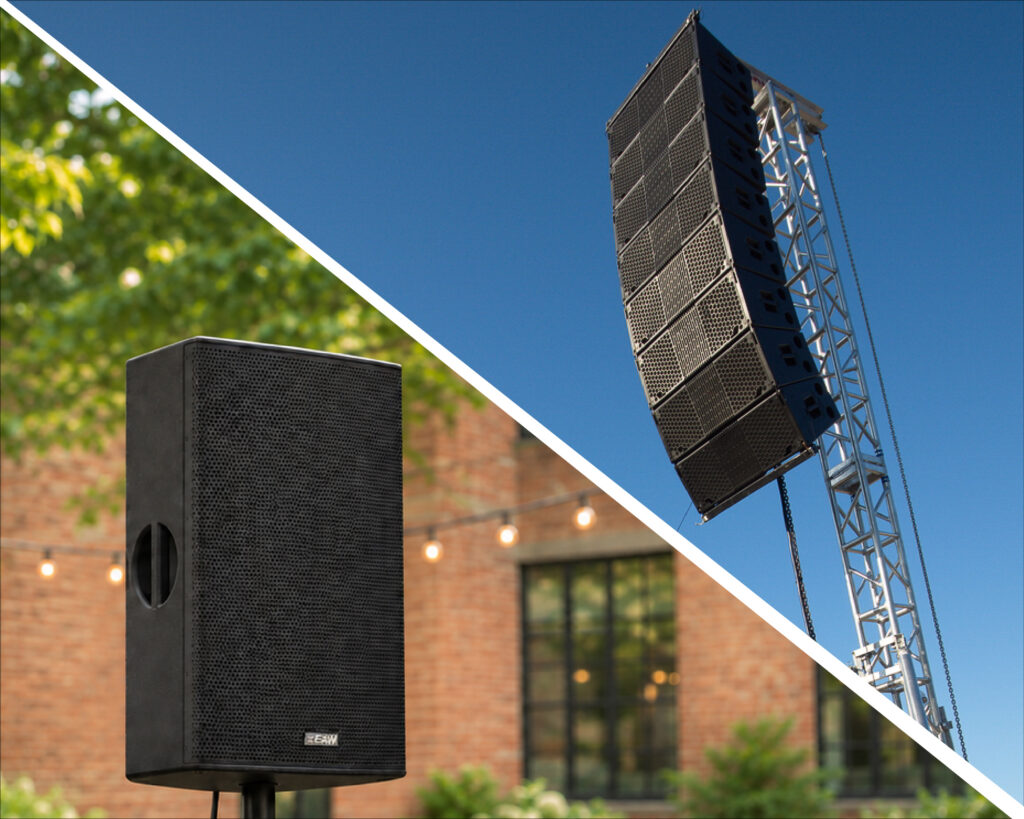
Line Arrays vs. Point Source Speakers: Which Fits Your Event?
The right speaker system depends on the shape of your audience area, the venue, and what’s happening onstage.
Line arrays and point source speakers are both used in professional event sound systems. Each can deliver clear speech and music when properly selected, positioned, and tuned.
For event planners, the useful question is which arrangement will provide consistent coverage within the space, schedule, and budget available.
THE QUICK ANSWER
Line arrays often suit events that need controlled coverage across deeper audience areas. Point source speakers offer flexible options for focused coverage, smaller spaces, and distributed systems. Audience size alone does not determine the right choice.
What’s the difference?
Line arrays use multiple speaker cabinets arranged together, usually in a vertical line. Their configuration and aiming help shape coverage across different audience distances.
Point source speakers provide coverage from individual enclosures. They can serve as the main system or cover specific areas throughout a venue.
Both approaches may need subwoofers, front fills, or delay speakers, depending on the program and audience layout.
When line arrays make sense
Line arrays can be useful for concerts, festivals, commencements, and other events where the audience extends well back from the stage. Their coverage control can help distribute sound between nearer and farther listening areas.
They also introduce practical requirements. Flown systems need suitable support, appropriate rigging, and installation time. Ground-stacked configurations have their own space and support requirements.
A line array should be selected because its coverage suits the event, with its footprint and deployment needs included in the plan.
When point source speakers make sense
Point source systems can work well for panels, corporate meetings, community stages, and live performances. They are also useful when guests occupy several separate areas, such as a reception room, entrance, and outdoor terrace.
A compact system may simplify setup where access, ceiling height, or installation time is limited. Larger point source systems can also support substantial events; the category is not limited to small portable speakers.
Placement still matters. Several speakers covering overlapping areas need careful coordination to maintain clarity.
What to share with your audio team
Help your production partner compare options by providing:
Audience area width, depth, and expected attendance
Stage location, seating layout, and standing areas
Speech, live music, or playback requirements
Ceiling heights and available rigging information
Load-in access, setup windows, and production budget
Ask how the proposed system will cover the front, back, and edges of the audience. That explanation is more useful than a speaker count alone.
Which speaker system fits your event?
We evaluate audience coverage, venue constraints, and program requirements to recommend an audio system that fits. Share your event plans with our team serving Baltimore, Washington, D.C., and Virginia.